
High-Temperature Battery Packs Developed Around the Thermal Mission
High-temperature battery architecture begins with verified ambient exposure, internal heat, loads, charging, installation, materials, interfaces, service, and production requirements. No temperature range, voltage, capacity, cycle life, rating, or certification is assumed.
Request an Engineering Review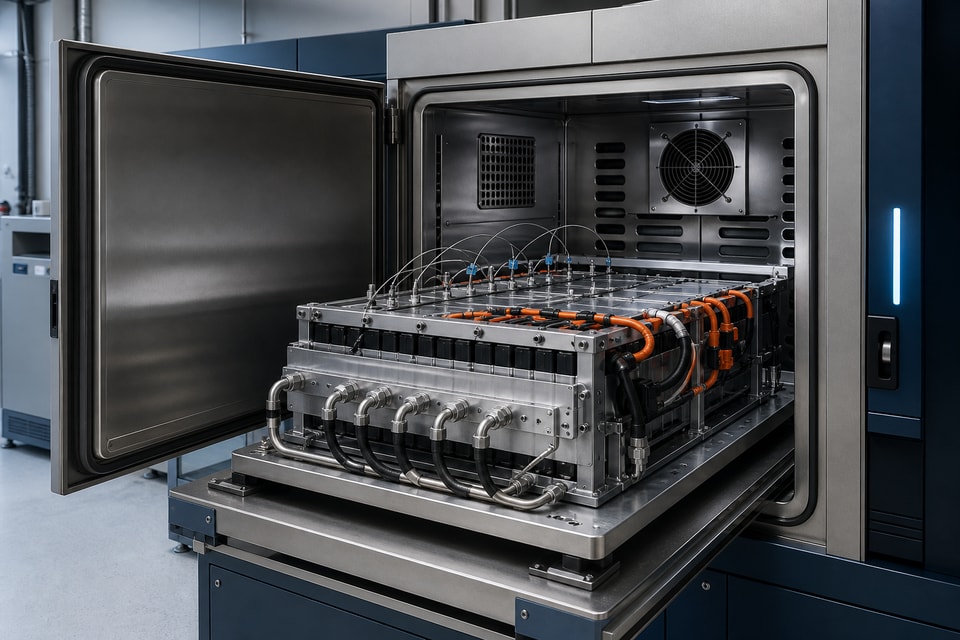
Ambient and internally generated heat interact
Duty cycle, charging, cell behavior, enclosure, insulation, ventilation, heat sources, interfaces, controls, and materials must be reviewed together.
What the design must resolve
Thermal Mission
Define ambient exposure, internal heat, loads, dwell, and charging.
Protection and Control
Coordinate sensing and allowable operation with host and charger.
Materials and Heat Paths
Develop enclosure, insulation, mounting, interfaces, and thermal paths.
Production Readiness
Control materials, assembly, inspections, and agreed checks.
Four connected design layers
Cell and Energy
Configured from verified mission evidence.
Protection and Intelligence
Coordinated with host and charger.
Mechanical and Thermal
Enclosure, mounting, materials, and heat paths are integrated.
Interface and Production
Connections, documentation, assembly, and inspection are controlled.
Where this approach may fit
Hot-Climate Monitoring
Enclosed Control Units
Process Equipment
Outdoor Electronics
Directions for engineering discussion
Hot-Climate Integration
Architecture and verification are configured to requirements. This is not a completed case.
Enclosed Platform Variant
No temperature, electrical, lifecycle, protection, or certification claim is implied.
From use case to repeat production
Define
Engineer
Prototype
Prepare
Common project questions
What thermal information is needed?
Share ambient, internal heat sources, loads, charging, dwell, airflow, installation, materials, and markets.
Can thermal features be customized?
Options are reviewed against verified requirements.
What temperature range is supported?
No range is assumed; required conditions and verification scope must be defined and agreed.
How are prototypes handled?
Scope follows project risks and maturity.
Discuss Your High-Temperature Battery Project
Share your thermal mission and application inputs for review.

Jiangsu Yongchang New Energy Technology Co., Ltd. and Shanghai YC Electrotech Co., Ltd. deliver certified lithium battery solutions backed by 15 years of experience, a 30,000 m² manufacturing base and exports to 100+ countries and regions.
CERTIFICATIONS
- CE & CCC
- IEC 62133 & GB/T 28164
- UN38.3 & MSDS
- RoHS, CB & REACH
CONTACT US
- Gaoqiao, Houxian, Danbei Town, Danyang City, Jiangsu Province 212300, China
- Tel: +86 511 8639 1768
+86 189 5282 5827
+86 189 1283 8663 - Email: contact@yc-batteries.com
- Web: www.yc-batteries.com


